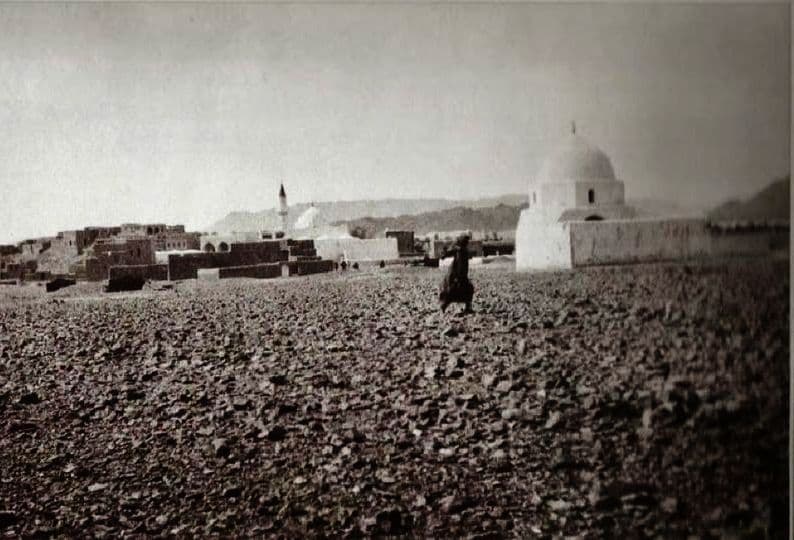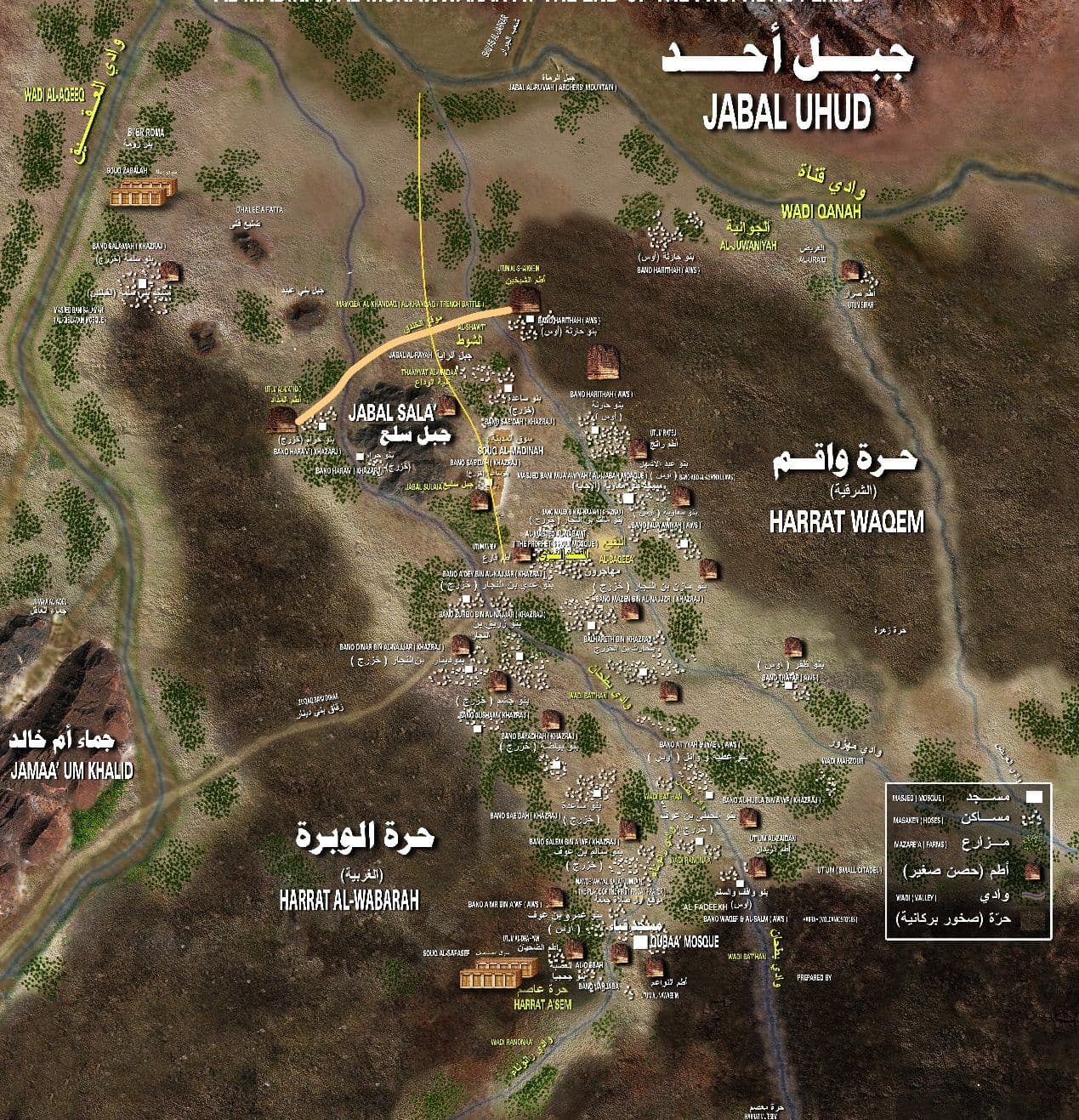


This land is located north of the city in a fertile area known as "Al-Ghabah" (the forest). This site highlights the importance the Messenger of Allah ﷺ placed on the revitalization of uncultivated lands. Indeed, he established a rule stating that whoever brings "dead" land back to life becomes its rightful owner. In this way, the Prophet ﷺ confirmed and consolidated the ownership of the people of Madinah (Ansar) over their existing lands, while distributing distant plots to the emigrants (Muhajirun) so they could revitalize them through agriculture. By cultivating them, these lands then became their property.
Among the projects resulting from these initiatives was the land of Al-Zubayr, located 6 km from the Mosque of the Messenger of Allah ﷺ. Al-Zubayr developed his land in an exemplary manner, showing great strength, initiative, and perseverance in his work. He innovated by creating a new irrigation system for his crops: he dug an artificial basin, known today as the Birka (pool/cistern) of Al-Zubayr, which he used for irrigation.
The Muhajirun were not a burden to the inhabitants of Madinah; rather, they were an added value, contributing to the city's development. Al-Bukhari reports that Asma’ said:
"Al-Zubayr married me when he had nothing, neither money nor property, except for a camel to carry water and his horse. I used to feed his horse and draw water. I also kneaded dough, even though I had not mastered bread-making. My neighbors among the Ansar used to bake the bread for me; they were sincere women. I used to carry dates on my head from Al-Zubayr’s land, which the Messenger of Allah ﷺ had granted him, at a distance of two-thirds of a league. One day, while carrying the dates on my head, I met the Messenger of Allah ﷺ accompanied by a group of Ansar. He called me and offered to let me ride behind him, but I felt too shy to walk among the men. I thought of Al-Zubayr and his ghayrah (protective honor/jealousy), for he was a very jealous man. The Messenger of Allah ﷺ understood my embarrassment and continued on his way. I told Al-Zubayr what had happened, and he said: ‘By Allah, it is harder for me to see you carrying those dates than to see you riding with him.’" Asma’ added: "Later, Abu Bakr sent me a servant capable of looking after the horse, and it was as if he had set me free."
Clarifying the first alleged inconsistency: The alleged inconsistency is found in the passage where the Prophet ﷺ offered to let her ride behind him. Some who raise this point imagine that the Prophet ﷺ intended for her to sit on the same mount as him, but this is an incorrect interpretation.
In Arabic, the expression "to ride behind him" (ikhlaf) does not necessarily mean sitting on the same mount, nor does it mean sitting on the mount while he remained on it. It is more likely that the Prophet ﷺ simply intended for her and her belongings to be carried while he himself rode another mount or walked. According to Ibn Hajar in his work Fath al-Bari, this is what Asma’ understood from the Prophet’s invitation in that context.
Her shyness about "walking with men" did not stem from being on the same mount, but from the simple fact of being the only woman in a group of men. From a legal perspective, this event shows that it is permissible for a woman to be a passenger in a convoy of men. Furthermore, the hadith does not mention that Asma’ had her face covered, nor that the Prophet ﷺ ordered her to do so. It can therefore be inferred that the full veil (niqab) pertained specifically to the wives of the Prophet ﷺ and not to all Muslim women.
The second controversy: The irrigation dispute The second point of discussion concerns a report by Al-Bukhari, narrated by ‘Urwa from Abdallah ibn al-Zubayr. A man from the Ansar had a dispute with Al-Zubayr before the Prophet ﷺ regarding the irrigation of their palm trees. The Ansari man asked Al-Zubayr to let the water pass through, but Al-Zubayr refused. They brought their dispute to the Prophet ﷺ.
The Prophet ﷺ advised Al-Zubayr to irrigate his field first and then let his neighbor benefit as well. The Ansari man became angry and accused the Prophet ﷺ of favoritism because Al-Zubayr was his cousin. The Prophet’s face reddened with displeasure; he then instructed Al-Zubayr to irrigate his field and hold the water until it reached the limits of his plot, called "Al-Jadr." Al-Jadr refers to a small dam or barrier placed between palm trees to define irrigation zones, acting like a wall to contain water in small basins around each tree.
Al-Zubayr later swore that the following Quranic verse was revealed following this event: “But no, by your Lord, they will not [truly] believe until they make you, [O Muhammad], judge concerning that over which they dispute among themselves and then find within themselves no discomfort from what you have judged and submit in [full, willing] submission.” (Surah An-Nisa 4:65).
Ibn Shihab added that the Ansar and others recognized the wisdom in the Prophet’s words. While the Prophet’s initial judgment was a compromise based on their relationship, after the man’s protest, he rendered a strictly just judgment that actually increased Al-Zubayr’s rightful share.
A note on the Forest (Al-Ghabah) Al-Bukhari emphasizes the importance of hard work and the revitalization of abandoned land. Al-Zubayr had purchased the forest area for 170,000, and later Abdallah sold it for 1,600,000. Abu Dawud reports that Ibn ‘Umar often visited the forest without breaking his fast or shortening his prayers (indicating it was considered part of the city's outskirts). Al-Bukhari and Muslim also mention that the Prophet’s minbar (pulpit) was crafted from trees from this forest, specifically the Tamarix Boveana (Al-Tarfe).